

The Swannanoa Valley House That Always Ran Cold
The thermostat wasn't wrong. The system was too small.
Previous service calls had arrived at a different answer: the thermostat offset was adjusted, setpoint margin was added, the homeowner was told to set the temperature a few degrees higher than she wanted to account for the "old house factor." The house was well-insulated and well-built. It wasn't old. It was just cold.
She'd lived with it for two winters. Adjusted. Layered. Set the thermostat to 72 and told herself that 68 was fine. She'd had the system serviced. She'd had the ducts checked. She'd been told the system was working correctly, and technically it was — it was doing what it could do. It just couldn't do enough.
The Swannanoa Valley is a particular place in a particular way that most HVAC load calculations don't account for. The valley floor sits between ridges that rise significantly on both sides, and at night cold air drains off those ridges and pools on the valley floor. It's a well-documented meteorological phenomenon — cold air is denser than warm air, and terrain channels it downward. The valley floor in the Swannanoa corridor can be 8 to 12 degrees colder than Asheville proper on clear, calm winter nights.
That's not a small difference. That changes the design day assumptions for any load calculation.
The system in her house had been sized using county-average heating degree data — the standard approach for WNC, and perfectly appropriate for most of the area. But she wasn't in most of the area. She was in a microclimate with meaningfully colder nights than the average assumes, in a valley bottom that collects the coldest air in the county on the nights when heating demand is highest.
An undersized system doesn't fail catastrophically. It just runs continuously without hitting setpoint. It keeps the house livable without keeping it comfortable. It's the heating equivalent of a car engine that can get you up the hill but not at highway speed — functional, limited, wrong for the task.
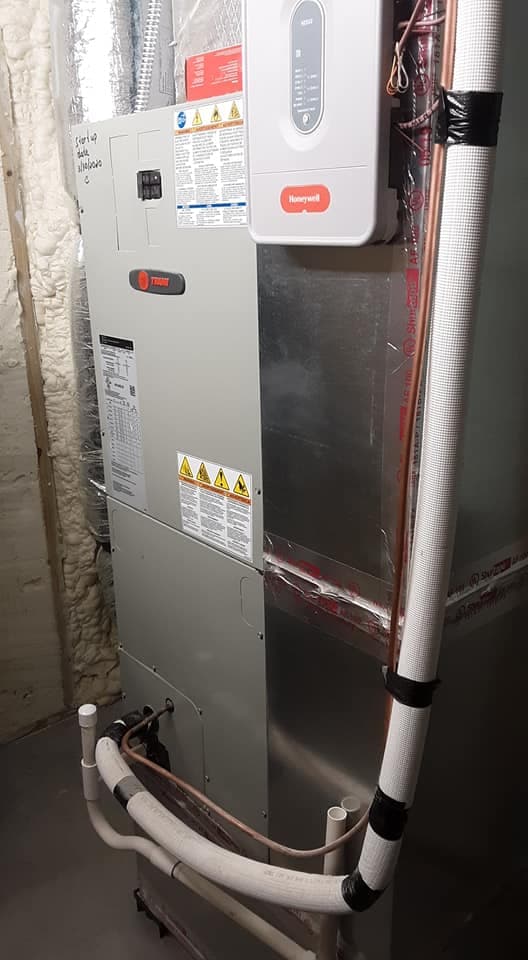
We did a site-specific load calculation. Corrected design day temperatures for the valley microclimate. Recalculated the required heating capacity. The existing system was about 20% undersized for the actual conditions.
New equipment, correctly sized. The house hit setpoint for the first time in two winters.
She called in March. Said she hadn't touched the thermostat since November.
The right-sized system for the right location. That's what fixed it.

About the Author
Vadim Melnic
Owner & Lead Technician, Fair Air Heating & Cooling·
EPA Section 608 Certified
Vadim has been serving the Asheville area since 2018, specializing in residential HVAC installation, service, and indoor air quality solutions. He founded Fair Air with a simple commitment: honest pricing, quality workmanship, and treating every home like his own.
Keep Reading
Related Articles
Your Heat Just Went Out on a WNC Winter Night — Here's What to Do
He fixed it himself. It was 10:30 PM, 17°F outside, and his heat had stopped. He fixed it in four minutes and didn't call anyone.
Preparing Your WNC Mountain Cabin for Winter — Before You Leave It Empty
The pipes didn't freeze. The system came back in spring exactly as it had been left. The cabin was ready for the first guests of the season in early April without an emergency call, a remediation company, or a plumber trying to explain where to find the water shutoff in a house...
The Shoulder Season Problem — When WNC Can't Decide What Month It Is
They don't argue about the thermostat in July. In July the answer is obvious. They argue about it in October, when it's 68° by noon and 41° by midnight and whatever they set at 7 AM is wrong by 4 PM.